| A Celtic Heritage |


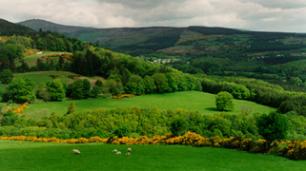
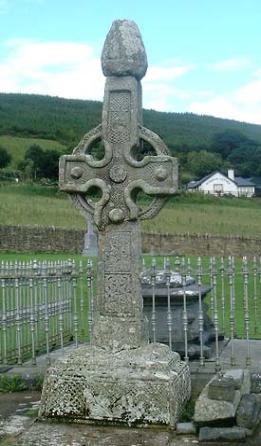
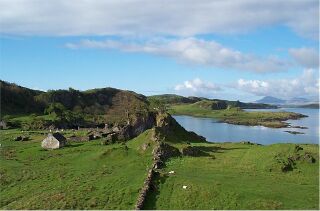

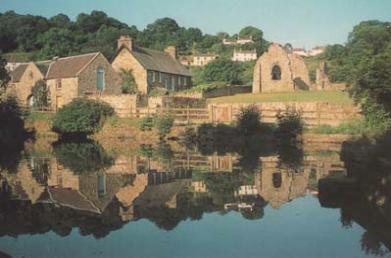
| Stone crosses dot the landscape of Ireland and Scotland, and other parts of Europe, home to Celtic Christianity. This High Cross is in Kilkieran County, Kilkenny, Ireland |
The seven Celtic nations of Scotland, Ireland (including Northern Ireland), Brittany, Wales, Cornwall,
Isle of Man and Galicia are regarded as the home of post-Roman Celtic culture, based on their shared
language, customs, art and culture. The first wave of Celts are believed to have made their way into
Ireland somewhere between 1000 and 700 BC. They spoke the insular dialect of Celtic known today as
q-Celtic (Goidleic---three forms of Gaelic---Irish, Scotch and Manx). Later, the Germanic invasions into
the British Isles brought p-Celtic (Brythonic---Breton, Cornish and Welsh).
The descendants of the Celts live in Ireland, Scotland, Wales, Brittany and all over the world. They
are great travelers and have moved in huge numbers to places such as America, Canada and Australia.
I don't believe it's overstating the fact to say that there are millions of English speaking people who
have at least some Celtic ancestry.
Isle of Man and Galicia are regarded as the home of post-Roman Celtic culture, based on their shared
language, customs, art and culture. The first wave of Celts are believed to have made their way into
Ireland somewhere between 1000 and 700 BC. They spoke the insular dialect of Celtic known today as
q-Celtic (Goidleic---three forms of Gaelic---Irish, Scotch and Manx). Later, the Germanic invasions into
the British Isles brought p-Celtic (Brythonic---Breton, Cornish and Welsh).
The descendants of the Celts live in Ireland, Scotland, Wales, Brittany and all over the world. They
are great travelers and have moved in huge numbers to places such as America, Canada and Australia.
I don't believe it's overstating the fact to say that there are millions of English speaking people who
have at least some Celtic ancestry.
In America, many Scots-Irish descendants of the Celts settled in the South and vestiges of the Celtic
culture can still be found in the language and customs and heard in the folk music of the region. In fact,
there's such a strong Celtic influence in the music that musicologists from the British Isles come to
America to study the folk traditions!
I was surprised to read a newspaper article yesterday concerning the small community of Folsom,
Louisiana, just north of New Orleans. The village is about to celebrate it's centennial and, to honor the
occasion, they hired an author to write it's history. Writer, David Bice, spent over a year in research and
interviewed 150 people. The book is titled, The Village of Folsom: A Centennial Celebration. The thing
that piqued my interest was this quote from the article: "Bice said, 'I was surprised because I've studied
geographical history, and I had no concept that these people have such a Scots-Irish background. I
realized it in my first interview, when a man used the term 'nary,' which is an Appalachian term. I
thought, 'That term does not belong in Louisiana.' That was my first clue."
My mother and members of her family who were of her generation and older, often used the term
"nary." How many of my Garrett cousins have heard their parents say, "It makes nary a bit of difference
to me!" I grew up hearing it, and some others I found when I went searching to see what phrases
today's Scots-Irish of Appalachia have in common with my Scottish and Scots-Irish families of Mississippi.
I've included some Gaelic phrases and their translations below. Of these, I found seven more terms
often used by my family, but I had never known their origin. It'll be interesting to see how many of you
are familiar with some of these phrases! Nancy
culture can still be found in the language and customs and heard in the folk music of the region. In fact,
there's such a strong Celtic influence in the music that musicologists from the British Isles come to
America to study the folk traditions!
I was surprised to read a newspaper article yesterday concerning the small community of Folsom,
Louisiana, just north of New Orleans. The village is about to celebrate it's centennial and, to honor the
occasion, they hired an author to write it's history. Writer, David Bice, spent over a year in research and
interviewed 150 people. The book is titled, The Village of Folsom: A Centennial Celebration. The thing
that piqued my interest was this quote from the article: "Bice said, 'I was surprised because I've studied
geographical history, and I had no concept that these people have such a Scots-Irish background. I
realized it in my first interview, when a man used the term 'nary,' which is an Appalachian term. I
thought, 'That term does not belong in Louisiana.' That was my first clue."
My mother and members of her family who were of her generation and older, often used the term
"nary." How many of my Garrett cousins have heard their parents say, "It makes nary a bit of difference
to me!" I grew up hearing it, and some others I found when I went searching to see what phrases
today's Scots-Irish of Appalachia have in common with my Scottish and Scots-Irish families of Mississippi.
I've included some Gaelic phrases and their translations below. Of these, I found seven more terms
often used by my family, but I had never known their origin. It'll be interesting to see how many of you
are familiar with some of these phrases! Nancy

| Whenever I dream, it seems I dream of Erin's rolling hills, Of all its lovely, shimmery lakes & little babbling rills. I hear a colleen's lilting laugh across a meadow fair, And, in my dreams, it almost seems to me that I am there. O, Ireland! O, Ireland! We're never far apart; For you & all your beauty fill my mind & touch my heart. It's a dear old land of leprechauns & wondrous wishing wells; Nowhere else on God's green earth, there be such lakes & dells. No wonder that the angels love that shamrock covered shore; It draws my heart toward home again & I love it more & more. Have you ever heard the story of how Ireland got its name? I'll tell you so you'll understand from whence old Ireland came. No wonder that I love that dear sweet land across the sea; For here's the way my dear old father told the tale to me: "A little bit of heaven fell from out the sky one day; And it nestled on the ocean, in a spot so far away. And, when the angels found it, it looked so sweet & fair; They said, 'Suppose we leave it? For it looks so peaceful there.' So they sprinkled it with stardust just to make the shamrocks grow; 'Tis the only place you'll find them, no matter where you go. And they dotted it with silver to make the lakes so grand; And when they had it finished, they called it 'Ireland!' " -- Author Unknown |
| GAELIC PHRASES and TRANSLATIONS Do any of these sound familiar to you? A braw pennie: A large sum of money. In grand fettle: In excellent condition or spirits A fiddler's biddin: A last-minute invitation A guid few: A good many Deid o the yeir: Winter Doun in the mou: Downcast Fair to middlin: Quite well Fine a ken: I know well Haud a wee: Stop a minute A Scotch kizzen: A distant relation At the hinner end: In the long run Out o thocht: Beyond belief Be cried: Have marriage banns read in church Staun guid for: Be surety for Fiddler's news: Stale news Wull ye no byde a wee?: Will you not tarry for a short while? A dripin roast: A good source of income Yir ees bigger 'nor yir belly: You have taken a larger portion of food than you are able to eat Hae an ee til: Have a liking for |
| This is in honor of my Irish ancestor, John S. Cain, who played the fiddle all of his life. THE FIDDLER OF DOONEY When I play on my fiddle in Dooney, folk dance like a wave of the sea; My cousin is priest in Kilvarnet, my brother in Moharubuiee. I passed my brother and cousin, they read in their books of prayer; I read in my book of songs I bought at the Sligo fair. When we come at the end of time, to Peter sitting in state, He will smile on the three old spirits, but call me first through the gate. For the good are always the merry, save by an evil chance, And the merry LOVE the fiddle and the merry LOVE to dance. And when the folk there spy me, they will all come up to me, With "Here is the fiddler of Dooney!" and dance like a wave of the sea. -- W. B. Yeats |
| Music: A Kiss from the Rose |