



| Excerpt from a letter written by Sister Marie Madeleine Hachard, member of the New Orleans Community of Ursulines, to her father in Rouen, France, in about 1730: "Our city called New Orleans is situated on the bank of the Mississippi River, which is at this place wider than the Seine at Rouen. [The city] is very beautiful, well constructed and regularly built. It suffices to tell you that there is a song sung here publicly in which it is said that this city has as fine an appearance as the City of Paris. There is here as much magnificence and refinement as in France. Gold and velvet goods are common, though three times dearer than at Rouen. The luxury that prevails in the city is the reason why it is difficult to distinguish the rich from the poor. All are of equal magnificence. Hunting, which commences in October, lasts all winter. It is done at ten leagues from the city. Wild oxen are caught in large numbers. We pay three cents a pound for that meat and the same price for venison, which is better than the beef and mutton which you eat at Rouen. In fact, we live on wild beef, deer, geese and wild turkeys, hens, ducks, pheasants, quails and other fowl. In a word, it is a delightful country all winter, and in summer, fish are common and very good. We accustom ourselves wonderfully well to the wild foods of this country and we are better off than we expected to be. Thank God, we have not yet wanted for anything." |
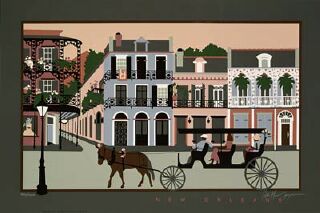
| Double shotguns are prevalent in the city. They are houses divided down the middle and occupied by two families; "shotgun" comes from the idea that you could fire a shotgun from the front door and the bullet would go straight through the house and come out through the back door. Most of my childhood was spent in a house much like the one pictured above. |
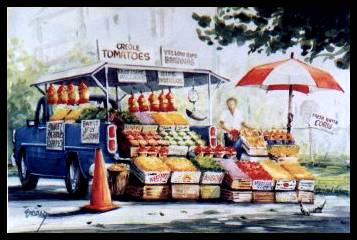
| Vendors who sold produce from the backs of trucks used to roam the streets of New Orleans every day. This custom continued well into the 1970's or so. The driver of the truck, as his predecessor who drove on a wagon and mule had done in years past, used to call out through the open window, "Bananas, got some fresh bananas today." Or whatever the fruit of the season happened to be. That wouldn't work so well today, since houses are closed shut with air conditioning. But in the days when I was a child, we used window fans and most people spent a great deal of time on their front porches, hoping to catch a breeze from the river. |
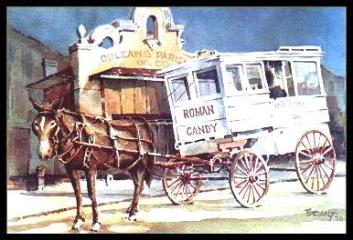
| The Roman Candy man STILL travels the streets of the city, parking here and there, delighting the occupants of whichever neighborhood he visits. The business was started by the current owner's grandfather and he has chosen to continue this wonderful tradition, known by every generation of New Orleans children since the early 1900's. But, he, also, has a website! |
| St. Charles Streetcar passes by the entrance to Audubon Park. |
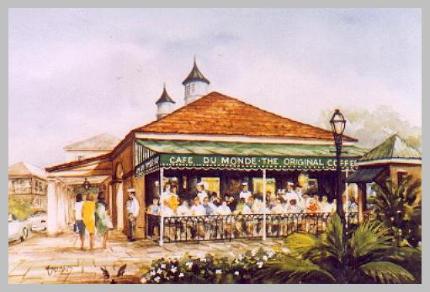
| The Cafe du Monde in the French Quarter, home of beignets and strong, hot coffee. Best place on the planet to be a people watcher!! |
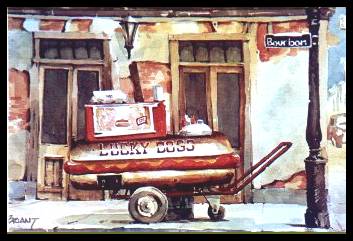
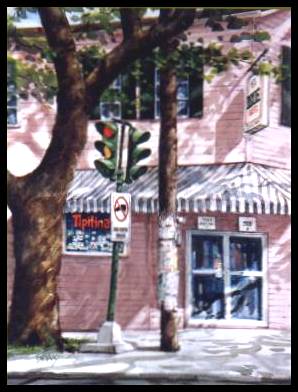
| Above, the Lucky Dog cart can always be seen in the French Quarter. Right, the famous Tipitina's Restaurant, located in Uptown New Orleans. |
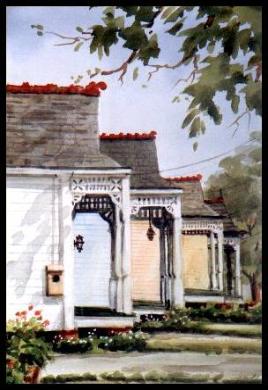
| New Orleans has some of the most interesting architecture in the country. The porch scene above, or, as many people in New Orleans refer to it, the "gallery," looks as if all it needs is a Mint Julep to complete the picture! |
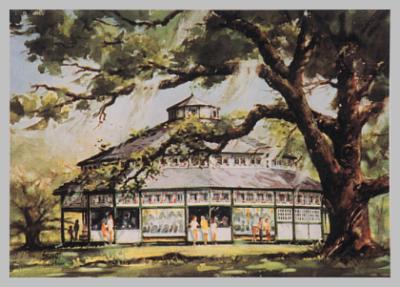
| Home of another landmark, the antique carousel at City Park. The carousel was refurbished a number of years ago and is absolutely beautiful. |
From Reminiscences of New Orleans:
The Vieux Carre, petite and architecturally charming, still sits like a quaint, old-fashioned jewel in the
midst of the modern garishness of the Quarter. To see her clinging to the simplicity of her early days,
her courtyards fragrant with sweet olive of a warm summer afternoon and second-story galleries
valentine-like with pink geranium and lacy grill, this is enough to make one nostalgic.
Time has robbed us of the charm of the pralinieres, in starched white apron and tignon, who went about
the streets of the old town vending Pralines aux Pacanes, La Colle and Candi Tire a la Nelasse for a
"picayune." A picayune was a coin in circulation in Colonial Louisiana worth approximately five cents. In
the early days, pralinieres, who had learned their skills in the old French ancestral homes and were
experts in the concocting of these Creole delicacies, hawked their sucreries creoles along Royal and
Bourbon Streets or in Jackson Square. In fact, so much a part of the daily life were these sweets that the
Creole children sang of them in their banquette games:
Soeur Rosalie au retour de matines
Plus d'une fois lui porta des pralines.
The Vieux Carre, petite and architecturally charming, still sits like a quaint, old-fashioned jewel in the
midst of the modern garishness of the Quarter. To see her clinging to the simplicity of her early days,
her courtyards fragrant with sweet olive of a warm summer afternoon and second-story galleries
valentine-like with pink geranium and lacy grill, this is enough to make one nostalgic.
Time has robbed us of the charm of the pralinieres, in starched white apron and tignon, who went about
the streets of the old town vending Pralines aux Pacanes, La Colle and Candi Tire a la Nelasse for a
"picayune." A picayune was a coin in circulation in Colonial Louisiana worth approximately five cents. In
the early days, pralinieres, who had learned their skills in the old French ancestral homes and were
experts in the concocting of these Creole delicacies, hawked their sucreries creoles along Royal and
Bourbon Streets or in Jackson Square. In fact, so much a part of the daily life were these sweets that the
Creole children sang of them in their banquette games:
Soeur Rosalie au retour de matines
Plus d'une fois lui porta des pralines.
THIS WEEK'S LINKS:
Bob Walker's New Orleans Radio & TV Shrine
Preservation Hall
Roman Candy Man
Audubon Zoo
Do you remember?
Music: Dream a Little Dream
Bob Walker's New Orleans Radio & TV Shrine
Preservation Hall
Roman Candy Man
Audubon Zoo
Do you remember?
Music: Dream a Little Dream

| Friday's Journal Index The Past Whispers - Home My G-Grandfather's Attic Old New Orleans Index (Click Back button to return) |

| ~~~~~~~~~ |