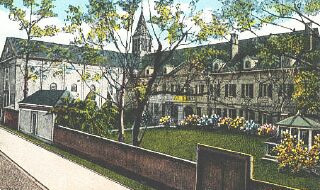
| Sister Xavier's Herb Garden |
| at the Historic Old Ursuline Convent |
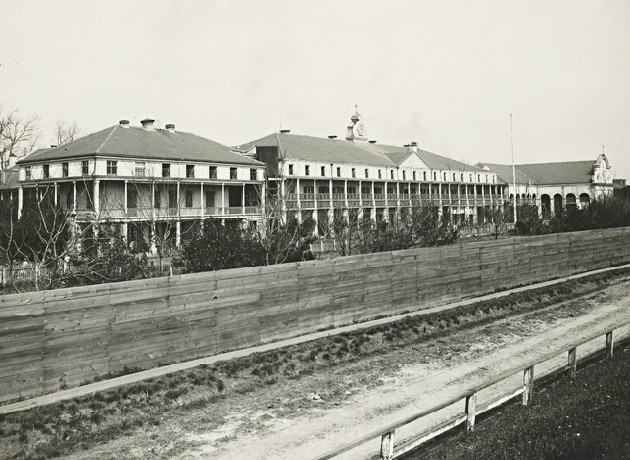
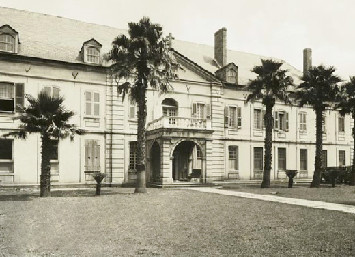
| The Old Convent is the only remaining French-colonial building in the United States and it is the oldest building in the Mississippi River Valley. Construction was completed in 1752. The Ursuline Convent was the first convent built in the United States. Photo above is ca. 1920. |
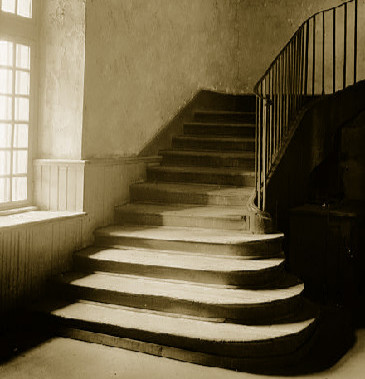
| This cypress staircase is even older than the building, as it was used in the Ursulines' first convent, completed in 1734. Photo ca. 1920's. |
The Ursuline nuns arrived in New Orleans in 1727 to a citizenry very grateful to receive
them. The sisters wasted no time in providing the community with urgently needed
medical care and, shortly thereafter, in establishing a school and orphanage for girls. (The
Ursuline Academy still thrives after more than 280 years and is the oldest girls' school in
the United States.) The extent of the Ursuline nuns' contributions to the city can't be
over-stated. And one of those contributions came in the form of Sister Francis Xavier
Hebert's herb garden.
In the 1700's, the section of the Old Ursuline Convent which now faces Chartres Street
was the rear yard of the convent. In this yard, Sister Xavier planted her herb garden. The
garden had been provided for in the treaty of 1726 between the Company of the Indies and
the Ursulines: "Sufficient ground, adjoining the house shall be granted...both to erect
there the new buildings of which there may be need and to make a garden for the
religious."
In colonial times, in addition to its uses in cooking and making beverages, the herb
garden was vital in providing medicines essential to comfort, well-being and healing.
Sister Xavier's herb garden became critically important to the lives of the people of New
Orleans.
From the Old Ursuline Convent Cookbook: "Sister Xavier compounded the medicines for
the Royal Hospital and became the first woman pharmacist in the New World. The teas,
infusions and distillates which she brewed from the herbs in her garden represented the
greater part of what was available in those days for the treatment of the sick. The Royal
Hospital commissioned by Louis XV stood next to the convent, since nursing the sick was
one of the primary reasons for the coming of the Ursulines to New Orleans in the first
place.
"The herbs that can be grown in the New Orleans climate successfully are thyme, sage,
rosemary, mint, sweet marjoram, basil, lavender, anise, caraway, bene, sage, catnip,
coriander, dill, fennel, horehound, pot marigold, dandelion, penny royal, rue, summer
savory, tansy and tarragon. The herbs were gathered at the height of their growth,
washed and tied into bundles to dry. They were covered with netting to protect them from
dust and insects, and hung in a warm place. When dry, the leaves, seeds or flowers were
picked and put into dark bottles, tightly corked, for storage."
Through the years, the Old Convent has served as a makeshift hospital for American and
British soldiers after the Battle of New Orleans, also, during yellow fever epidemics; as an
orphanage; an Archbishop's residence; a school; the seat of the Louisiana Legislature; a
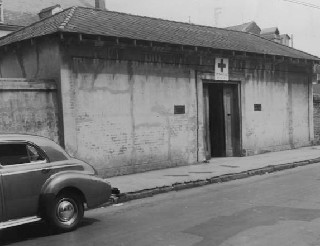
WWII Red Cross center; a residence hall for local bishops; the residence of the Oblate
Fathers, who served the Italian community, and more. The Old Ursuline Convent
underwent extensive restoration in the 1970's and is now a part of the Archbishop Antoine
Blanc Memorial complex and functions as an archive for the Archdiocese of New Orleans.
Among its holdings are documents dating back to 1718. (Be sure to see a letter written to
the Ursuline sisters by Thomas Jefferson, in 1804, at the bottom of the page.)
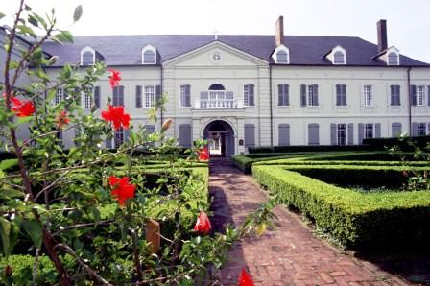
Today, thanks to Chef Horst Pfeifer of the Bella Luna Restaurant, who planted and
maintains it, an herb garden, once again, flourishes in the rear yard of the Old Convent.
Sister Xavier would be very pleased! -- Nancy
them. The sisters wasted no time in providing the community with urgently needed
medical care and, shortly thereafter, in establishing a school and orphanage for girls. (The
Ursuline Academy still thrives after more than 280 years and is the oldest girls' school in
the United States.) The extent of the Ursuline nuns' contributions to the city can't be
over-stated. And one of those contributions came in the form of Sister Francis Xavier
Hebert's herb garden.
In the 1700's, the section of the Old Ursuline Convent which now faces Chartres Street
was the rear yard of the convent. In this yard, Sister Xavier planted her herb garden. The
garden had been provided for in the treaty of 1726 between the Company of the Indies and
the Ursulines: "Sufficient ground, adjoining the house shall be granted...both to erect
there the new buildings of which there may be need and to make a garden for the
religious."
In colonial times, in addition to its uses in cooking and making beverages, the herb
garden was vital in providing medicines essential to comfort, well-being and healing.
Sister Xavier's herb garden became critically important to the lives of the people of New
Orleans.
From the Old Ursuline Convent Cookbook: "Sister Xavier compounded the medicines for
the Royal Hospital and became the first woman pharmacist in the New World. The teas,
infusions and distillates which she brewed from the herbs in her garden represented the
greater part of what was available in those days for the treatment of the sick. The Royal
Hospital commissioned by Louis XV stood next to the convent, since nursing the sick was
one of the primary reasons for the coming of the Ursulines to New Orleans in the first
place.
"The herbs that can be grown in the New Orleans climate successfully are thyme, sage,
rosemary, mint, sweet marjoram, basil, lavender, anise, caraway, bene, sage, catnip,
coriander, dill, fennel, horehound, pot marigold, dandelion, penny royal, rue, summer
savory, tansy and tarragon. The herbs were gathered at the height of their growth,
washed and tied into bundles to dry. They were covered with netting to protect them from
dust and insects, and hung in a warm place. When dry, the leaves, seeds or flowers were
picked and put into dark bottles, tightly corked, for storage."
Through the years, the Old Convent has served as a makeshift hospital for American and
British soldiers after the Battle of New Orleans, also, during yellow fever epidemics; as an
orphanage; an Archbishop's residence; a school; the seat of the Louisiana Legislature; a
WWII Red Cross center; a residence hall for local bishops; the residence of the Oblate
Fathers, who served the Italian community, and more. The Old Ursuline Convent
underwent extensive restoration in the 1970's and is now a part of the Archbishop Antoine
Blanc Memorial complex and functions as an archive for the Archdiocese of New Orleans.
Among its holdings are documents dating back to 1718. (Be sure to see a letter written to
the Ursuline sisters by Thomas Jefferson, in 1804, at the bottom of the page.)
Today, thanks to Chef Horst Pfeifer of the Bella Luna Restaurant, who planted and
maintains it, an herb garden, once again, flourishes in the rear yard of the Old Convent.
Sister Xavier would be very pleased! -- Nancy
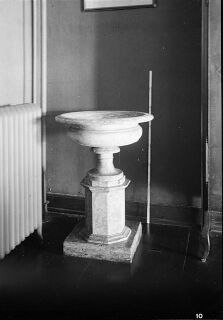
| This baptismal font also dates back to the first convent. |
| Taken not long before the building received some renovation, ca. 1890's; photo by George Francois Mugnier. |
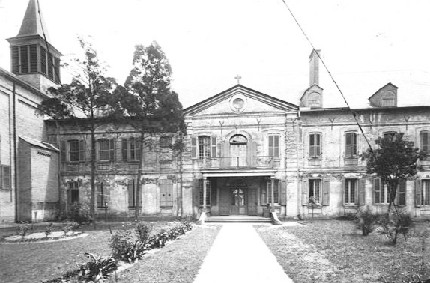
| The old convent after a face lift; early 1900's. |
| The convent gatehouse as Red Cross Center during World War II. |
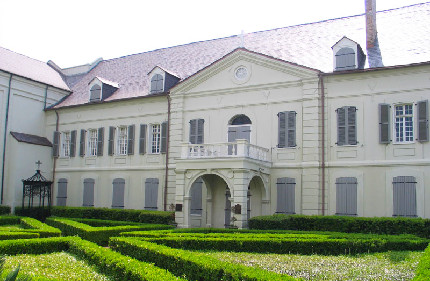
| Above and below, the old Ursuline Convent as it looks today. |
| Besides the first structure, which was replaced in 1752 with the convent seen above, the Ursulines have had convents in two other locations in the city: |

| In 1824, the Ursuline sisters sold the historic convent on Chartres Street and moved to the buildings seen above, located in the 9th Ward. |
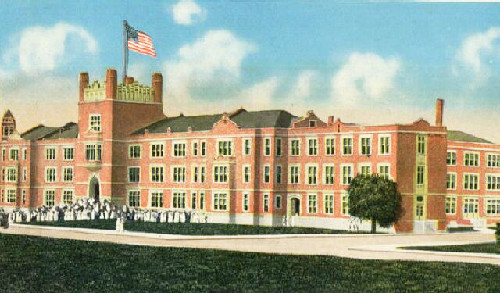
| In 1910, the Ursulines moved their convent & academy to State Street, in the Uptown area of the city. Today, Ursuline Academy is the oldest continually operating Catholic school in the United States, as well as, the oldest continually operating girls' school in the country. Image above, ca. 1928. |
| You might also enjoy: The Landing of the Ursulines Back to Old New Orleans Whispers - Home |
Letter written to the Ursuline nuns in 1804 by Thomas Jefferson (Click here to
see an image of the letter.)
Washington, May 15, 1804
I have received, holy sisters, the letter you have written me wherein you
express anxiety for the property vested in your institution by the former
governments of Louisiana. The principles of the constitution and government of
the United States are a guarantee to you that it will be preserved to you, sacred
and inviolate, and that your institution will be permitted to govern itself
according to its own voluntary rules, without interference from the civil
authority. Whatever the diversity of shade may appear in the religious opinions
of our fellow citizens, the charitable objects of your institution cannot be
indifferent to any; and its furtherance of the wholesome purposes of society, by
training up its younger members in the way they should go, cannot fail to ensure
it the patronage of the government it is under. Be assured it will meet all the
protection which my office can give it.
I salute you, holy sisters, with friendship and respect.
Thomas Jefferson

see an image of the letter.)
Washington, May 15, 1804
I have received, holy sisters, the letter you have written me wherein you
express anxiety for the property vested in your institution by the former
governments of Louisiana. The principles of the constitution and government of
the United States are a guarantee to you that it will be preserved to you, sacred
and inviolate, and that your institution will be permitted to govern itself
according to its own voluntary rules, without interference from the civil
authority. Whatever the diversity of shade may appear in the religious opinions
of our fellow citizens, the charitable objects of your institution cannot be
indifferent to any; and its furtherance of the wholesome purposes of society, by
training up its younger members in the way they should go, cannot fail to ensure
it the patronage of the government it is under. Be assured it will meet all the
protection which my office can give it.
I salute you, holy sisters, with friendship and respect.
Thomas Jefferson
| The link to this page is: http://www.thepastwhispers.com/NO_SisterXavier.html |