| This city won't wash away. This city won't ever drown. |
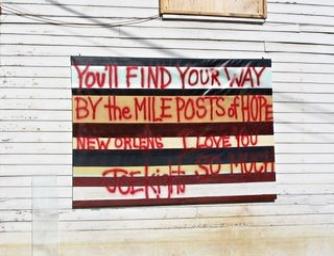
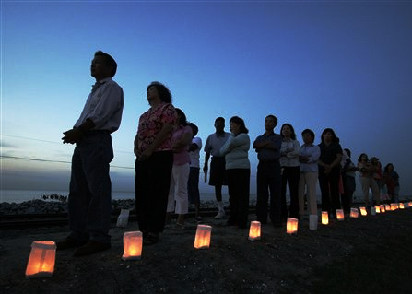
| This is dedicated to the people of Metropolitan New Orleans, to the memory of those who perished and in honor of those who survived and put their lives back together. |

| We'll just carry on digging our graves In solid marble above the ground. Maybe our bones will wash away, But this city won't ever drown. -- Steve Earle, "This City" |
| "This CIty" written and performed by Steve Earle. The link to this page is: http://www.thepastwhispers.com/This CIty.html August 29, 2005: When Time Stood Still August 29, 2009: Heart Old New Orleans Whispers - Home |
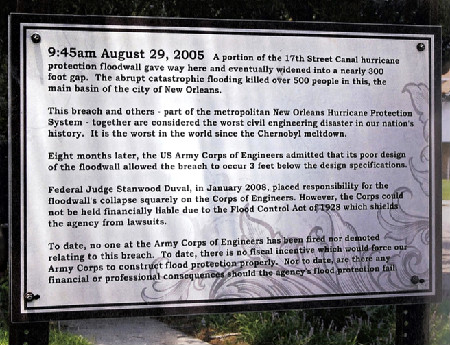
Sign, Bellaire Drive and 30th Street, Lakeview, New Orleans
"9:45 a.m. August 29, 2005 A portion of the 17th Street Canal hurricane protection floodwall gave way
here and eventually widened into a nearly 300 foot gap. This abrupt catastrophic flooding killed over
500 people in this, the main basin of the city of New Orleans (over 1,100 died in the metropolitan area).
"This breach and the others, together, are considered the worst civil engineering disaster in our
nation's history. It is the worst in the world since the Chernobyl meltdown.
"Eight months later, the U.S. Army Corps of Engineers admitted that its poor design of the floodwall
allowed the breach to occur 3 feet below the design specifications.
"Federal Judge Stanwood Duval, in January, 2008, placed responsibility for the floodwall's collapse
squarely on the Corps of Engineers. However, the Corps could not be held financially liable due to the
Flood Control Act of 1928, which shields the agency from lawsuits.
"To date, no one at the U.S. Army Corps of Engineers has been fired nor demoted relating to this breach
or the other breaches. To date, there is no fiscal incentive which would force the U.S. Army Corps to
construct flood protection properly. Nor to date are there any financial or professional consequences
should the agency's flood protection fail."
"9:45 a.m. August 29, 2005 A portion of the 17th Street Canal hurricane protection floodwall gave way
here and eventually widened into a nearly 300 foot gap. This abrupt catastrophic flooding killed over
500 people in this, the main basin of the city of New Orleans (over 1,100 died in the metropolitan area).
"This breach and the others, together, are considered the worst civil engineering disaster in our
nation's history. It is the worst in the world since the Chernobyl meltdown.
"Eight months later, the U.S. Army Corps of Engineers admitted that its poor design of the floodwall
allowed the breach to occur 3 feet below the design specifications.
"Federal Judge Stanwood Duval, in January, 2008, placed responsibility for the floodwall's collapse
squarely on the Corps of Engineers. However, the Corps could not be held financially liable due to the
Flood Control Act of 1928, which shields the agency from lawsuits.
"To date, no one at the U.S. Army Corps of Engineers has been fired nor demoted relating to this breach
or the other breaches. To date, there is no fiscal incentive which would force the U.S. Army Corps to
construct flood protection properly. Nor to date are there any financial or professional consequences
should the agency's flood protection fail."